

A persecuted people, denied the rights of citizens in the country of their suffering, finds a coalition prepared to fund their relocation, but this coalition is unstable. Guilt and idealism sit on one side, calculation and convenience on the other. The people paying for the ships agree on almost nothing except the exit.
The destination is a land the settlers identify as ancestral, occupied by people they have never met. A Western power helps fund the project, and the settlers do not understand themselves as conquerors. They see themselves only as survivors, returning to the continent their ancestors were taken from.
The land is already occupied, and the settlers know this. Local forces meet them with violence; the settlers respond, fortify, unite, and consolidate. Within decades a state has been declared, its constitution borrowing the scaffolding of the country that had expelled them, its legitimacy resting on the persecution its founders survived. The state expands past the initial settlements, and the people already living there are governed by institutions they did not design. Resistance turns into rebellion, uprisings are crushed, and forced labor follows.
Generations pass and the settlers’ descendants become the ruling class, and then just the unmarked national identity. Their political monopoly eventually ends, but the state itself survives. The state’s borders, official language, constitutional habits, and even its name for itself all remain. What began as settlement becomes a country, and what began as a political question becomes history.
You already think you know which story this is.
This is a story about Liberia.
mississippi in africa
There is a place on the Liberian coast called Mississippi in Africa. Its capital is named Greenville. I went to a Mississippi university, sat in Mississippi classrooms, and nobody ever mentioned that the Magnolia State has a sequel.
Start with Isaac Ross, a planter in Jefferson County, Mississippi. When he died in 1836, he left a will promising freedom to the people he had enslaved at Prospect Hill, but only through removal.
Not just leave the county, but leave the country. His heirs fought the will for a decade because the people in it were the estate. When the freed families finally sailed in 1848, they landed in Sinoe County, the former Mississippi-in-Africa colony. Its capital, Greenville, had been named for Judge James Green, one of the Mississippi men who helped make the removal project possible.
Ross’s will made the bargain plain. You can be free, but not here.
The American Colonization Society (ACS), founded in 1816, brought together people who agreed on almost nothing. Some white abolitionists had concluded the United States would never let a free Black population flourish, and white supremacists looked at that same population and saw a threat to slavery and to white rule. Two groups with opposing reasons landed on the same conclusion: Black people should leave. So the money came along with the ships, and the first settlers reached the West African coast in the early 1820s.
The people on those ships do not fit one clean moral category. Some chose Liberia because America had made an ordinary life practically impossible. Some, like the Prospect Hill families, were offered freedom only on the condition that they go. Others were Africans pulled off intercepted slave ships and were set ashore in settlements they never selected. They were victims of American white supremacy and useful to institutions that wanted a free Black population out of their sights.
But being used is not the same as having no agency. The settlers negotiated, fought, governed, expanded, and eventually declared a republic, becoming a political class with power and interests of their own.
And the land was not empty. The Indigenous people groups — Kru, Grebo, Kpelle, Bassa, Dei, and others — had governments, trade relationships, rivalries, and histories of their own. They were not one people, nor were they waiting to be found, nor were they scenery.
The founding "transaction" was a threat backed by legalized paperwork. In December 1821, U.S. Navy Lieutenant Robert Stockton sat down to negotiate with a Dei ruler the Americans called King Peter for the land at Cape Mesurado. When the talks took longer than expected, Stockton pointed a pistol at his head, and the pistol did what the argument could not, and the deed was signed. Liberian schoolbooks would then call this a “purchase” for the next century and a half.
The people already there did not accept the arrangement and ended up attacking the settlement in 1822. The settlers held Cape Mesurado in a battle later folded into national legend around a settler woman named Matilda Newport, who supposedly fired a cannon into the attackers with a coal from her pipe. Remember her name.
In 1847, the coastal settlements declared the independent Republic of Liberia. The declaration was drafted by Hilary Teage, a Baptist preacher and newspaper editor, and it's heavily influenced by the political language of the country that had expelled its authors. The capital was already named after an American president, the flag has one star and eleven stripes, and if it looks familiar, it is supposed to. The governing class carried American names, practiced American Christianity, and reproduced the social style of the country it escaped.
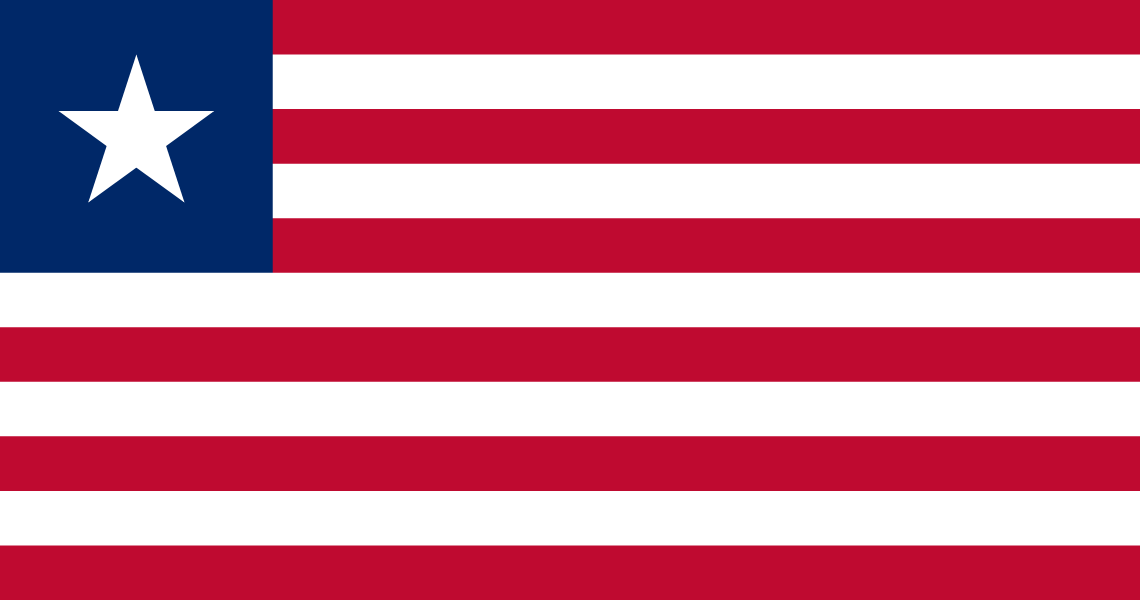
Meanwhile the country it escaped refused to recognize it. The United States did not recognize Liberia until 1862, because recognizing a Black republic meant treating Black diplomats as diplomatic equals in Washington.
America built this colony and wouldn’t bother to look at it.
Inside the new republic, the Americo-Liberian settlers remained a small minority of the territory the state claimed. The constitution limited citizenship to people of African descent, broad enough on paper to include Indigenous Liberians, but voting ran through property most did not hold, and the interior was administered, not represented. The distinction between citizen and governed subject survived underneath the language of a common Black republic.
The True Whig Party took power in 1878 and did not give it back until 1980. In 1927, President Charles D. B. King won reelection with many times more votes than there were registered voters. His opponent, Thomas Faulkner, answered by exposing the shipment of laborers to Spanish plantations on Fernando Pó under conditions that were not analogous to slavery so much as a continuation of it.
The League of Nations sent a commission in 1930. It documented coercive recruitment, beatings, unpaid labor, abusive fines, and the involvement of senior officials, and described the export of workers in conditions hardly distinguishable from slave raiding. President King and Vice President Allen Yancy resigned rather than face impeachment.
The republic was founded in 1847 by people who told the truth about what had been done to them, and by 1930 it had found a way to do something recognizably similar to somebody else. Here lies our issue.
the grammar i knew already
I did not arrive at Liberia through Liberia, but through a sentence I have heard my entire life from people I know, love, and respect: Black people cannot be racist.
The sentence is an attempt to protect something true, wanting to keep racism from being reduced to bad manners and name-calling. In America, white supremacy had (has) law behind it, financial capital backing it, and the support of the state. Black prejudice against white people does not carry the same institutional reach even if the insult may travel in the opposite direction.
But I have also watched the sentence move from "racism is bigger than individual prejudice" to "nothing we do to another group can ever belong to the category of racial harm." And once the definition says we can’t be the aggressor, everything we do gets another name: prejudice, conflict, an understandable response to history; anything except the word that might require us to stop. But the harm does not disappear because we picked a definition under which we cannot be its author.
The same person can be subordinated along one line and dominant along another. A Black American can live under white supremacy and still hold power over an immigrant, an employee, a child, a non-English-speaking person, or any person from a group with less pull in that particular room. The word victim describes what was done to you, but it does not describe everything you are free to do next.
Liberia takes that interpersonal problem and scales it to the state level. The Americo-Liberian settler was subordinated in relation to white America, useful in relation to the colonization movement, and dominant in relation to an Indigenous farmer living under the expanding republic. The distinct positions ran simultaneously, not consecutively.
Which is why “the oppressed became the oppressor” is a sanitized explanation; it gets rid of the nuance. It implies the first identity stopped existing before the second one arrived, as if history changed the nameplate on the door. The settlers did not stop being people America had enslaved and excluded just because they acquired power somewhere else.
the “we”
Liberia is not asking whether victims can become villains. It is asking what a wound inflicted upon a people is allowed to excuse. A scar does not come with instructions, but people surely write different lessons onto it.
The first lesson is never again: this should not happen to anyone, anywhere, including at our hands if we ever get the power to do it. That lesson is not natural and takes discipline. It asks a people whose survival depended on protecting their own to extend the lesson to people outside the group, including people whose interests now cut against theirs.
The second lesson is smaller: never again to us. Never again to me. And it is completely understandable. You do not survive danger by starting with universal abstraction; you start with protecting your own. But the smaller lesson carries its own permission slip, making some lives absolute and everyone else negotiable.
Most traditions preach the first lesson and practice the second, usually with better branding, and Liberia wrote the fork directly into its founding document.
When the Declaration turns to the identity of its founders, it says: “We, the people of the Republic of Liberia, were originally the inhabitants of the United States of North America.” It then names the injuries. The founders “were debarred by law from all the rights and privileges of men.” They were “excluded from all participation in the government.” They were “taxed without our consent.” Every syllable of that is true, but listen to the pronoun.
The “we” stops at the population that came from America, and the people already living inside the territory being claimed do not appear as co-authors of the republic. They appear, but just not as authors.
They show up first as sellers, the “lords of the soil” from whom the land was acquired: consent enough to bless the sale, but not enough to join its founding.
They show up a second time as converts, “the native African bowing down with us before the altar of the living God,” proof that the settlers believed they carried religious light to the coast. The native makes it into the us of the prayer, but never makes it into the we of the republic.
The declaration remembers exclusion from the previous government, but the state it founded would exclude Indigenous Liberians from meaningful political participation for a century. It remembers taxation without consent, but the state would push hut taxes and labor demands into an interior with no real voice in the government imposing them. It remembers slavery all too well, but within living memory of the founders, officials of the republic would be caught running labor systems a League of Nations commission compared to slave raiding.
The state built its claim from a wound, then found a way to make the wound again. Its own founding text calls the first version tyranny and the second version civilization.
The declaration even insists, unprompted, that “Liberia is not the offspring of grasping ambition.” Nobody really defends themselves against an accusation they haven’t heard. This founding needed a story where settlement is refuge and the expansion is uplift, and the people already there are sellers, converts, rebels, or just subjects. Literally anything but founders.
Liberia declared independence on July 26, twenty-two days after America's Independence Day, in a document clearly cosplaying Thomas Jefferson. The settlers may have left America, but they didn’t forget to pack the Fourth of July in their luggage.
Five years later, in Rochester, Frederick Douglass stood up and asked his white audience: What to the Slave is the Fourth of July? “This Fourth of July is yours, not mine.” He is standing inside America’s founding text pointing at a “we” that was never built to include him. Douglass refused colonization outright, because Black Americans live here, have a right to live here, and mean to live here, and removal doesn’t fix an exclusive “we.”
And Douglass was right, because twenty-two days after the fourth, on another shore, the exported “we” opened its first sentence, and the lords of the soil were standing outside it.
Nowhere else to go is a true sentence, but it is also, eventually, an answer given to the people who were already there. That is never again to me, written into the foundation of a constitution.
what success erases
One Day, Everyone Will Have Always Been Against This.
— Omar El Akkad
With Liberia, the file is open because the verdict is no longer up for debate.
Call the project successful, but only if survival is the whole definition. The republic survived and its founding class held the state for over 100 years. Its borders, its official language of English, its constitution, and its name all outlived the monopoly.
Then, on April 12, 1980, Samuel Doe, a master sergeant from the Krahn people of the interior, killed President Tolbert in the executive mansion, and thirteen officials of the old order were shot on a beach in Monrovia ten days later. Indigenous Liberians had never disappeared into the settler identity. They were always the overwhelming majority, and they became the center of everything that came after, including horrors of their own.
One of the first things the new government did was abolish Matilda Newport Day. For decades the republic had kept a national holiday around a legend of a settler woman firing a cannon into the people who were already there. Schoolchildren from the interior were marched through pageants honoring this legend, and the holiday survived every reform era. It died only when the political order that needed it also died.
Liberia makes the rule hard to miss: we are most comfortable naming the structure at the exact moment naming it can no longer interrupt anything. Liberia can be called a settler project in any classroom on earth because the republic is not waiting to find out whether it survives. The archive is open because the case is closed.
A completed state can build the museum, apologize in the right tense, and revise the textbook without reopening the settlement. The history becomes speakable at the same rate the present claim becomes unspeakable.
Sometimes that is not hypocrisy, because generations really do build a shared society on top of the original injury, and people acquire attachments that are not reducible to conquest. The people whose ancestors fought the coastal settlements are Liberians now, and I do not have a clean method for separating conquest from belonging in that sentence.
But sometimes “we are all one nation now” just means one side won thoroughly enough, for long enough, that everyone was eventually required to speak inside its categories. The settlers’ language becomes the language, and their borders become the borders. Political success turns a disputed settlement into the white noise of ordinary life, and from inside the finished project, those two stories are nearly impossible to tell apart.
Waiting for the safety of hindsight means waiting until the vocabulary of contest has been retired, until the project has had enough time to rename power as survival and the victory as the natural shape of the world.
By then, the argument is permitted. And by then, everyone will have always been against it.
after the asterisk
You knew another story was in the room.
I have heard the defense made on behalf of the Israeli state in almost the same grammar I heard as a kid about who can and cannot be racist: the persecution is so long, so murderous, so central to the state's reason for existing, that the state stays legible as the endangered party even while it exercises overwhelming power over somebody else. The wound arrives first in every sentence, and the wound is asked to notarize whatever comes after it.
Liberia is not Israel, and Jewish people are not a state any more than Black Americans were the ACS. But Liberia interrupts the alibi, and it blocks one escape route: a people can be genuine victims of one order, instruments of that order against somebody else, and later holders of independent power, and their original suffering can stay completely true through every stage without settling the morality of a single thing they do afterward. The suffering is a fact. It is not a permission slip.
The sentence I grew up on, Black people cannot be racist, held up a room I liked being in. But following Liberia to the end meant admitting that people who look like me, people whose ancestors were owned like mine, held a gun-signed deed and a forced-labor docket and a holiday about a cannon. I wanted the exemption, but the archive said no.
The method for our founding stories and everybody else's: look at the injuries a founding text names when they are done to its authors, then look for what the same text calls those injuries when the new state does them to someone else. Look at who gets to suffer in the first person, and who only ever appears in the third.
And ask what never again means in the mouth saying it. A rule against all persecution, or a promise that one people will never again be on the losing side of it.
Notice who is missing from the "we."