
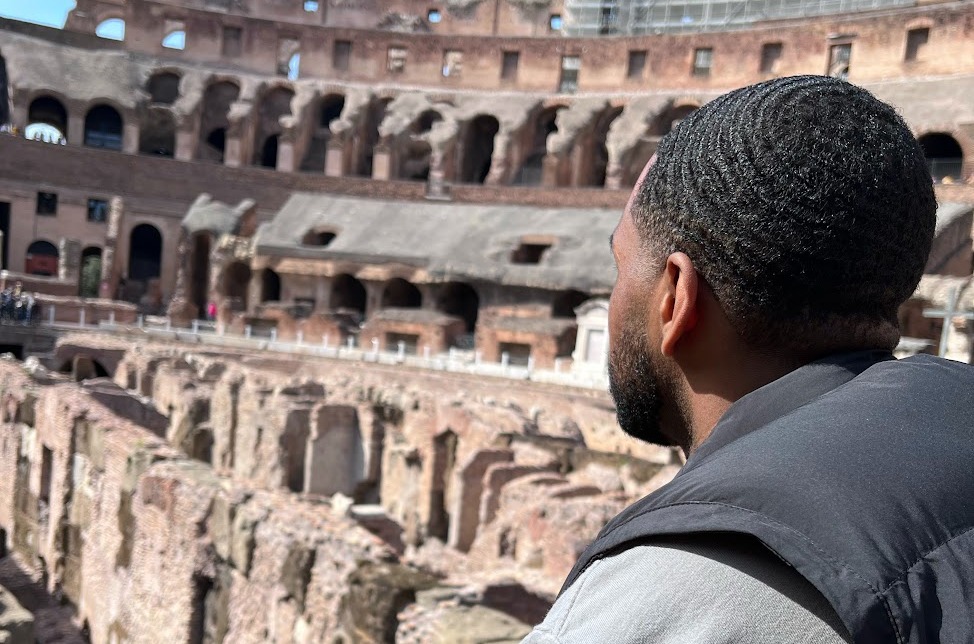
Rome is not a place.
Rome is a mindset.
It is a fortress of certainty built on a cornerstone of rigid doctrine. To be clear, this isn’t the humble faith of the Jewish mystic, but the institutional machine that demands that people conform. It sells safety — or, at least, the illusion of it. To be a citizen of Rome is to know exactly where the boundaries are — to know who is in, who is out, and who is saved.
Rome doesn’t do nuance. Empires aren’t interested in your inner life; they’re interested only in compliance. They don’t request answers from a book club to parse whether Jesus was an ad-hoc, freelance so-called king “of some other world.” They don’t ask what he meant, nor do they care.
They ask what his claim does in public.
And if it smells like rival dominion, be sure, they don’t respond with dialogue. They respond with crucifixion.
That’s the point of this metaphor: Rome is not a philosophy seminar, but a security state. And while theology might be an ever-evolving conversation, this brand of viral apologetics is its border patrol.
Because empires get nervous when people start walking toward the exits.
Periodically, a citizen of this empire posts a public defense of the realm. On the surface, these posts look like arguments — standard apologetic defenses of the temple using logic and analogies — but they function as decrees. If the “map” I wrote about last week is a guide to a world that doesn’t exist, these posts are the barricade. They aren’t offering directions, but only warning travelers not to leave.
When we look at public apologetics not as theology but as sociology, the goal shifts. We have to realize that we aren’t watching a debate. What we are watching is a performance of loyalty designed to keep the remaining citizens from looking too long beyond the walls.
the view from the forum
The actual job of a post like this isn’t to persuade the exile; we’ve already left, wandering the wild lands “after the asterisk” and sifting for meaning without an emperor’s permission.
A recent iteration of this genre invoked 2 Timothy to diagnose us, claiming we have “itching ears” and have gathered teachers to suit our own desires. Rhetorically, this diagnosis isn’t designed to reach the exile, because the chasm is much too wide. Functionally, the verse serves to reclassify intellectual disagreement as a moral defect. It protects the insider from the burden of engaging the actual argument — or asking if the exile’s reasons are true.
The letter itself is widely regarded by critical scholars as pseudepigraphal — written in Paul’s name by a later author borrowing his authority to stabilize an emerging ecclesiastical order and police the boundaries of “sound teaching.” In other words, the verse is doing boundary-work in the earliest centuries exactly the way this post does today.
“For the time is coming when people will not put up with sound teaching, but, having their ears tickled, they will accumulate for themselves teachers to suit their own desires.”
— 2 Timothy 4:3 (NRSVUE)
Instead, the post is performed for the Forum — the internal audience of peers watching to see if the guard is awake. It is a space that rewards certainty as strength and treats empathy as a compromise of the security state — where asking honest questions is labeled as rebellion and compassion is dismissed as “coddling.” In a world where loyalty is currency, public certainty is how you pay your tithes. By loudly refuting the deconstructor, the post doesn’t need to win a soul, but it functions solely to secure standing among the faithful.
The speaker becomes the one who scratches the ears of the insiders.
The guard assures the city that the defect is in us, not the system, signaling to the other guards that no one has fallen asleep at their post.
the santa claus
A common move in this genre is to infantilize the departure. The centerpiece of a recent manifesto was a comparison to Santa Claus, alongside a reference to a bad cover of a legendary vocalist. The argument goes like this: deconstruction is self-worship masked as sophistication. Or it’s simply adulthood: you outgrow magic like Santa.
The logic asks: if someone sings a famous song poorly and off key, are you mad at the performer or the original artist? Blame the obviously bad karaoke performance, not the source.
The singer-and-song analogy is the Empire’s favorite way to protect itself: separate the “System” from its fruits. If the church harms you, blame the singer, not the song.
This is the function of dismissive phrases like “church hurt”: it recasts systemic damage as a personal sensitivity, a bad experience with a few flawed people, instead of an outcome the system reliably produces.
Defenders will say that bad actors don’t invalidate the doctrine, but outcomes are not random accidents. They reflect incentives, authority structures, information control, and disciplinary practices. These systems produce predictable outputs: shame, silencing, gatekeeping, and fear-based retention.
A system that cannot be judged by its outcomes is a system that ultimately cannot be held accountable.
It becomes perfect by definition and presupposition: immune to the evidence, untouched by history, and forever preserved behind glass.
Santa is a false comparison because Santa has no hell.
The analogy is a rhetorical downgrade intended to lower the stakes, but it fails because the stakes are not the same. When you stop believing in Santa, your siblings don’t weep for your eternal soul. Your mother doesn’t fear you will be tortured forever. You don’t lose your community, your marriage, or your long-term friendships.
No one whispers about you at Thanksgiving.
To reduce that trauma to a childhood fable isn’t only a bad argument, but a complete moral dodge, erasing the cost of the ticket.
In traditions shaped by Eternal Conscious Torment, the alternative to the system is infinite ruin. The apologetic framework insists that belief is a free choice, but the offer is structured as coercion.
Imagine I tell you I want to take your sister on a date. I promise it’ll be the best night of her life. But if she says no, I’m locking her in my basement and lighting it on fire. You wouldn’t say she has a choice. You’d call the police.
That is the offer on the table: love me or burn.
Defenders often appeal to Pascal’s Wager to sanitize this threat, framing belief as rational risk management — “why play around with your soul?” Yet when pressed about whether they fear the hells of other faiths or rival threat-claims, the answer is rarely yes. The asymmetry shows us that the fear isn’t about mathematical probability, but about identity, geography, and the deep, communal cost of belonging.
When this structural coercion is named, a common softener appears: “It’s not about fear, it's love; we just want you to be with us in heaven.” This affection is likely sincere, but it functions to spotlight the reward while hiding the gun. It reframes a threat of eternal separation as a longing for connection, masking the enforcement mechanism behind a veil of love.
The system keeps a gun on the table even when it tells the citizen they are free to choose. It enforces this “freedom” with a looming deadline, reminding us that “when your eyes close for the final time,” the debate is over. The doctrine structurally turns death into leverage, weaponizing its inevitability to panic the doubter, coercing the signing of the contract before the lights go out.
certainty as aesthetic
So why do they do it? Why the aggressive certainty?
Why the posture of a gladiator?
Because certainty hurts less than sadness.
To admit that the exile might have a point is to admit that the Empire has its cracks. Once you validate the deconstructor’s pain, you essentially indict the system that caused it. And for a citizen of Rome, that is terrifying. If the walls are crumbling, then — in their eyes — the barbarians might get in.
Or even worse, the citizens might have to go out.
So they choose the anesthetic. They choose the black-or-white, no-grey decree over the hard work of empathy. They frame the deconstructor as broken, rebellious, or morally defective, because the alternative is to sit in the grief of a fractured family. Uncertainty threatens not just their theology, but their sense of safety and belonging.
Because public certainty is rewarded socially with status and praise for “faithfulness,” it becomes a performance, not just a feeling. This isn’t necessarily malice; it's the mechanics of the empire kicking in to protect its core, often bypassing the conscious intent of the individual.
Grief is heavy, because it requires silence, listening and maybe admitting that you don’t have all the answers.
But Rome isn’t built for grief.
Rome has a world to conquer.
after the asterisk
The temptation, for those of us on the outside, is to enter the arena. We want to fight back, dismantle the logic, point out the fallacies, and scream about the harm.
We really want to storm the gates.
But that is what the Empire wants. The spectacle of the fight only strengthens its walls. It gives the citizens a common enemy and proves that we are exactly who they say we are: angry, bitter, and ultimately dangerous.
There is a quiet power in simply refusing to pick up the sword.
We don’t need to burn Rome down. We just need to realize we don’t live there anymore, and we can let the Romans have their decree. We can let the Forum have its applause, while we acknowledge the fear behind the certainty without accepting the shame it tries to project.
We are not defective, nor are we children finding out about Santa.
We are adults who looked at the cost of the Empire and decided it was too high. We chose the wilderness. And out here, under the open sky, we don’t need an emperor to tell us who we are. We walk away not to win a debate, but because we no longer need the anesthetic.
We refuse to let our grief be treated as a threat, or our doubts classified as defects.
Let the gates close.
We have walking to do.